
In an era where climate action is no longer optional, understanding the environmental impact of your products is a competitive and ethical necessity. Whether you’re a manufacturer, supplier, or brand owner, knowing your Product Carbon Footprint (PCF) helps you meet sustainability goals, comply with regulations, and respond to growing consumer demand for transparency.
What is a Product Carbon Footprint (PCF)?
A Product Carbon Footprint (PCF) measures the total greenhouse gas (GHG) emissions associated with a single product over its entire lifecycle or a defined portion of it. This includes emissions from raw material extraction, manufacturing, transportation, use, and disposal. Unlike a corporate carbon footprint (which covers a company’s operations and scopes 1, 2, and 3), a PCF focuses specifically on one product and its lifecycle emissions, typically expressed in carbon dioxide equivalent (CO₂e).
Why Calculate a PCF?
Here’s why PCFs are gaining importance across industries:
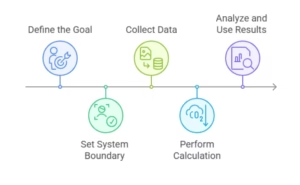 How to Calculate Your Product’s Carbon Footprint[/caption]
Step 1: Define the Goal of Your PCF
Start by asking: Why are you calculating this footprint? Your goals determine the depth, precision, and methodology of your analysis.
How to Calculate Your Product’s Carbon Footprint[/caption]
Step 1: Define the Goal of Your PCF
Start by asking: Why are you calculating this footprint? Your goals determine the depth, precision, and methodology of your analysis.
- Meet customer and supplier requirements
- Gain a competitive edge with low-carbon products
- Identify cost-saving opportunities in energy and logistics
- Support green marketing and avoid greenwashing
- Align with investor expectations and ESG reporting
- Prioritize areas for decarbonization
How to Calculate Your Product’s Carbon Footprint[/caption]
Step 1: Define the Goal of Your PCF
Start by asking: Why are you calculating this footprint? Your goals determine the depth, precision, and methodology of your analysis.
- Are you looking for a rough estimate or a detailed breakdown?
- Is this for internal tracking or external communication?
- Do you need to meet regulatory or customer-specific thresholds?
- Are you comparing similar products to choose a greener option?
- Cradle-to-Grave: This is the most comprehensive boundary, including all GHG emissions from the extraction of raw materials (the "cradle") through production, transport, use, and finally, disposal (the "grave"). It covers both upstream and downstream supply chain activities. This is typically used for final products, such as diesel.
- Cradle-to-Gate: This boundary includes emissions from the extraction of raw materials up to the point the product leaves the factory gate. It excludes emissions from downstream activities like delivery to the customer, product use, or disposal. This is often used for intermediate products where the final use is unknown, like an aluminum ingot. Cradle-to-gate PCFs are sometimes referred to as 'embodied carbon' or 'embedded carbon'.
- Activity Data: Quantitative data on inputs, materials, energy usage, transportation, etc.
- Emission Factors: Scientific values that convert activity data into CO₂e. These come from trusted databases like DEFRA, IPCC, or Ecoinvent.
- Primary Data : Direct measurements from your operations or suppliers.This could be data from your own sites (e.g., fuel consumed, electricity used, material inputs, direct process emissions). It also includes primary data from your suppliers and customers related to your product. Obtaining supplier/customer data might require asking them directly or using specialized software. Using asset-level data provides the most accuracy.
- Secondary/Default Data (if necessary): If primary data isn't available, you can use average emissions factors or modeled data from public sources or specialist databases. This is useful for high-level estimates or filling data gaps.
- Convert different GHGs (e.g., methane, nitrous oxide) into CO₂e
- Allocate emissions if your process produces multiple products (as per GHG Protocol rules)
- Normalize results per unit (e.g., per kg of product, per item, etc.)
- Report emissions to regulators, customers, or investors
- Identify hotspots in the supply chain for emission reduction
- Guide procurement and supplier selection
- Compare products based on sustainability
- Design lower-emission alternatives
- Support eco-labeling or product certifications (e.g., EPDs)