

India has implemented four Labour Codes from 21 November 2025. India’s Labour Codes include the Code on Wages, 2019, the Industrial Relations Code, 2020, the Code on Social Security, 2020, and the Occupational Safety, Health and Working Conditions Code, 2020. Together, these Codes replace 29 existing labour laws and establish a consolidated framework governing wages, employment conditions, workforce protection, and workplace safety. This serves as a recommended reference for companies, contractors, and workforce groups covered under applicable labour regulations.
Implications for India’s Labour Force
These updated laws aim to reinforce job security, reduce exploitative practices, and create a framework for worker protections across sectors.
Implications for Companies
The new framework sets uniform standards for employment practices and workplace obligations across States. Companies must operate under a common structure for wage rules, workplace conditions, safety requirements, and workforce records.
Brief History of the Labour Codes
Most of India’s labour laws were created in the 1930s to 1950s, when the economy and nature of work were very different. These laws stayed in place for decades, which left India with 29 separate and often outdated Central labour laws. The rules were fragmented, and not aligned with new forms of employment. This created a high compliance load for both workers and businesses. The four Labour Codes aim to replace these older laws with a more modern framework that reflects current economic and workplace needs.
The key reasons behind this reform include:
- Simplifying compliance: Having many separate laws made compliance difficult for employers and workers.
- Streamlining enforcement: Different authorities under different laws created confusion and made enforcement inconsistent.
- Updating old laws: Most labour laws were written before Independence, so they needed to be aligned with today’s economic conditions and workplace technologies.
Major Labour Law changes are as follows:
- Employment formalization: Establishes mandatory appointment letters for all workers to provide written proof of employment.
- Social security coverage: Ensures PF, ESIC, insurance, and other benefits for all workers, including gig and platform workers, under the Social Security Code 2020.
- National minimum wage coverage: Guarantees statutory minimum wages for all employees under the Wage Code 2019.
- Preventive healthcare: Mandates annual free health check-ups for all workers above 40 years of age.
- Timely wage: Mandates on-time wage payments to improve financial reliability for workers.
- Women’s workforce participation: Establishes conditions for women to work during night hours with consent and required safety measures.
- ESIC coverage: Expands ESIC applicability by allowing voluntary coverage for establishments with fewer than 10 employees and establishing mandatory coverage for any establishment with at least one employee in hazardous processes.
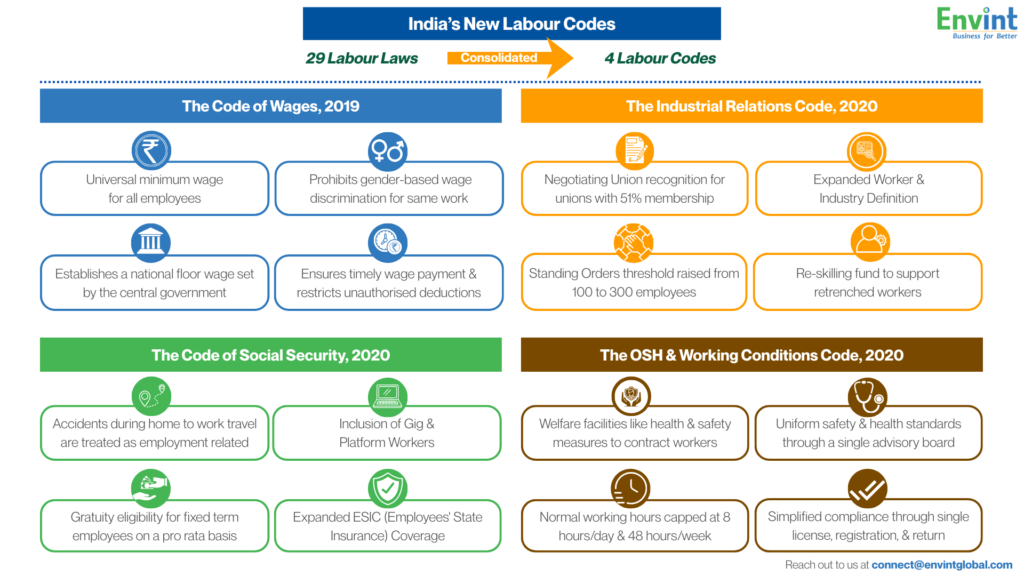
How the Labour Codes Reshape India’s Labour Landscape
- Standard employment structure: Creates uniform employment norms across industries, reducing ambiguity for workers.
- Employer responsibilities and workforce rights: Outlines obligations and entitlements in a single integrated framework.
- Labour force participation: Supports workforce inclusion by recognizing diverse employment models.
- Employment data availability: Enhances data quality through standardized documentation and reporting.
Relevance to ESG and Sustainability
The Labour Codes align with labour indicators in India’s BRSR and BRSR Core frameworks. They establish requirements on wage fairness, worker health, and workplace safety, while defining procedures for maintaining workforce records. By supporting reporting on workforce wellbeing, gender participation, and social protection, the Codes enable enterprises to demonstrate responsible labour practices across both direct operations and contractor networks.
At Envint
We help organizations understand how regulatory changes such as the Labour Codes influence human capital, human rights, DEI, governance, ESG reporting, and regulatory compliance. Our work supports organizations in understanding regulatory implications and aligning HR systems, policies and practices to meet future needs. Write to us at connect@envintglobal.com to know more.
Click here to know about ESG compliance in India.