

As global pressure to act on climate change intensifies, the financial sector is emerging as a critical player in driving decarbonization. Financial institutions hold the power to influence emissions through capital allocation, investment strategies, and portfolio management. But to align with climate goals, a structured, science-based approach is essential.
That’s where the SBTi Financial Institutions Net-Zero Standard comes in.
What Is the Financial Institutions Net-Zero Standard?
Developed by the Science Based Targets initiative (SBTi), the Financial Institutions Net-Zero Standard is a comprehensive framework designed to help financial entities align their lending, investing, and portfolios with global net-zero targets. Unlike earlier near-term criteria, this Standard expands its scope across more asset classes, includes clear fossil fuel transition policies, and integrates metrics for deforestation and energy exposure.
Who Can Use the Standard?
The Standard is primarily intended for financial institutions generating 5% or more of their revenue from lending, asset ownership/investment, asset management, insurance underwriting or capital market activities. This includes public and private institutions, pension funds, and sovereign wealth funds.
[caption id="attachment_8997" align="aligncenter" width="1024"]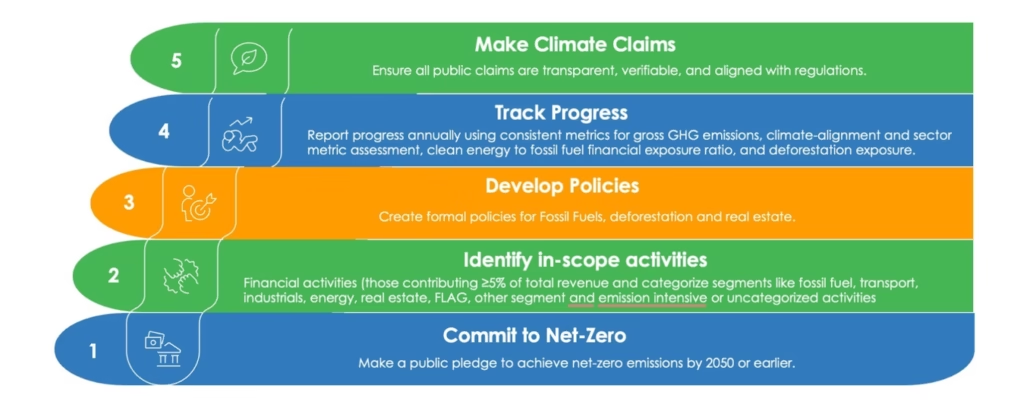 Key steps of the SBTi Net Zero Standard for Financial Institutions[/caption]
1. Make a Net-Zero Commitment
Institutions should begin by making a public commitment to reach net-zero by 2050 or earlier. They should define organizational boundaries and identify “in-scope” financial activities (those contributing ≥5% of total revenue).
Categorize these activities into four segments:
Segment A: Fossil fuels.
Segment B: Transport, industrials, energy, real estate, FLAG (Forests, Land, and Agriculture).
Segment C: Other sectors.
Segment D: Emissions-intensive or uncategorized activities.
2. Conduct a Base-Year Assessment
Select a base year (typically the most recent available) and conduct the following assessments:
Key steps of the SBTi Net Zero Standard for Financial Institutions[/caption]
1. Make a Net-Zero Commitment
Institutions should begin by making a public commitment to reach net-zero by 2050 or earlier. They should define organizational boundaries and identify “in-scope” financial activities (those contributing ≥5% of total revenue).
Categorize these activities into four segments:
Segment A: Fossil fuels.
Segment B: Transport, industrials, energy, real estate, FLAG (Forests, Land, and Agriculture).
Segment C: Other sectors.
Segment D: Emissions-intensive or uncategorized activities.
2. Conduct a Base-Year Assessment
Select a base year (typically the most recent available) and conduct the following assessments:
Key steps of the SBTi Net Zero Standard for Financial Institutions[/caption]
1. Make a Net-Zero Commitment
Institutions should begin by making a public commitment to reach net-zero by 2050 or earlier. They should define organizational boundaries and identify “in-scope” financial activities (those contributing ≥5% of total revenue).
Categorize these activities into four segments:
Segment A: Fossil fuels.
Segment B: Transport, industrials, energy, real estate, FLAG (Forests, Land, and Agriculture).
Segment C: Other sectors.
Segment D: Emissions-intensive or uncategorized activities.
2. Conduct a Base-Year Assessment
Select a base year (typically the most recent available) and conduct the following assessments:
- GHG emissions inventory (Scopes 1, 2, and portfolio Scope 3).
- Climate alignment of financial activities.
- Exposure ratio: clean energy vs. fossil fuels.
- Deforestation exposure (mandatory by 2030).
- Gross GHG emissions for segments A, B, and C, as well as methodology, assumptions, data sources and data quality. Separate reporting is required for: - Scopes 1 and 2, and scopes 1, 2 and 3 portfolio-level emissions - Carbon removals, carbon credits and avoided emissions (if relevant) - Fossil fuel-related emissions, and as data quality allows, methane emissions
- Climate-alignment and sector metric assessment
- Clean energy to fossil fuel financial exposure ratio
- Deforestation exposure.
- Transparent
- Verifiable
- Aligned with applicable regulations
Explore Envint’s Responsible Investment services to integrate ESG considerations into investment decisions.
Explore Envint’s Climate Action services to support your organization’s decarbonization goals.