

Carbon credits and offsets function as market instruments that support verified emission reductions. Both operate within regulated and voluntary markets and support compliance with climate targets.
What Are Carbon Credits and How Do They Work?
Carbon credits were introduced as a way to finance emissions reductions beyond a company’s own operations. Organizations can purchase a verified carbon credit that represents ‘one tonne of CO₂e reduced or removed’ to compensate for residual emissions as part of their broader climate strategy.
What Are Carbon Offsets and How Do They Work?
Carbon offsets represent one tonne of carbon dioxide equivalent avoided or removed outside a regulated cap. Projects generate offsets by reducing emissions through renewable energy, energy efficiency, or nature based interventions. An accredited standard verifies the reduction and issues credits that buyers can retire to compensate for emissions they cannot eliminate.
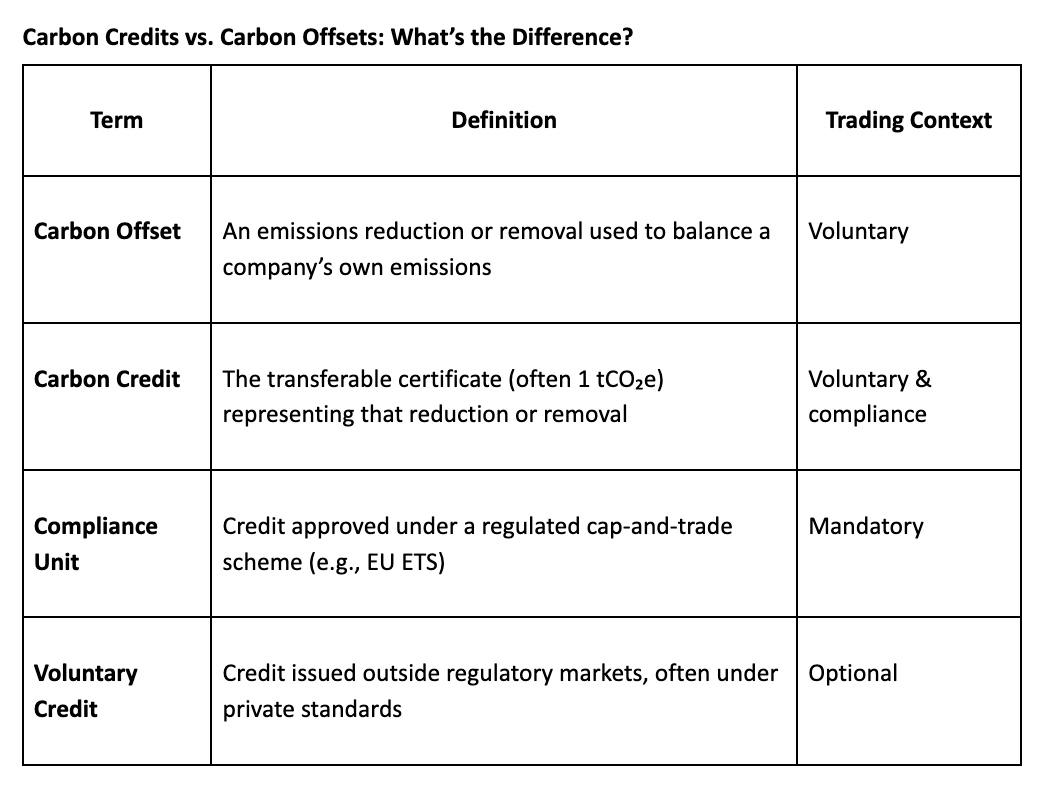
Key takeaway: Every offset is a credit, but not every credit qualifies as an offset for corporate net-zero plans.
Why Carbon Credits Matter for Businesses Today
1. The voluntary carbon market continues to attract corporate investment despite tighter quality expectations and slower transaction volumes, reflecting a shift toward fewer, higher integrity credits.
2. Many companies with net-zero commitments continue to use carbon credits to address residual emissions that cannot yet be eliminated.
After years of controversy over forest offsets and 'phantom' credits, the voluntary carbon market is consolidating. Instead of millions of questionable projects, the next phase is about fewer, science-backed, and more transparent ones. The market is not disappearing; it is evolving toward fewer, higher-quality, and higher-priced credits.
Carbon Credit Regulations: What’s Changing?
India's Carbon Credit Trading Scheme (CCTS): Established under the Energy Conservation (Amendment) Act, 2022, the scheme is being implemented by the Bureau of Energy Efficiency (BEE). It builds on India's earlier Perform, Achieve and Trade (PAT) scheme, which required designated energy-intensive industries to reduce their energy consumption per unit of production against prescribed targets. Industries that exceeded these targets could earn tradable Energy Saving Certificates (ESCerts), while those falling short could purchase certificates to meet their obligations. Under CCTS, the focus shifts from energy efficiency targets to greenhouse gas emission intensity targets, with a phased transition of eligible sectors from PAT to the new framework.
Paris Agreement Article 6: Article 6 establishes a framework for countries to cooperate on climate action through international carbon markets and non-market approaches. It enables countries to trade verified emission reductions under Article 6.2 and generate carbon credits through the UN-supervised mechanism under Article 6.4. Article 6.8 covers non-market cooperation, including climate finance and technology transfer. The framework emphasises transparent accounting and corresponding adjustments to prevent double-counting and maintain the environmental integrity of carbon credits.
How to Spot Low-Quality Carbon Credits:
1. Weak Additionality: Would the project happen without credit revenue?
2. Short Permanence: Storage timelines too short compared to CO₂ impacts.
3. Baseline Inflation: Overstated “business as usual” scenarios.
4. Leakage: Emissions reduced in one area but increased elsewhere.
5. Poor MRV (Monitoring, Reporting, Verification): Sparse or unreliable data.
Tools and Technologies to Verify Carbon Credit Integrity
New technologies are reshaping how carbon projects are verified, making quality more transparent than ever.
1. Digital MRV: Satellites and AI monitor biomass, soil carbon, and methane leaks in real time.
2. Independent Registries: Choose carbon credits listed on recognised registries that follow established standards for credit verification, transparency and environmental integrity. Prioritise registries aligned with the ICVCM's Core Carbon Principles (CCPs).
3. Insurance-Backed Permanence: Reserves or guarantees against reversal.
4. Blockchain Traceability: Prevents double counting and fraud.
Buyer’s Checklist: How to Choose High-Quality Carbon Credits
Is the project CCP-aligned or CRCF-ready?
Has independent verification confirmed additionality and permanence?
Are baselines and leakage controls transparent?
Are credits removals (e.g., DAC, biochar) or avoidance (e.g., cookstoves)?
Are buffer pools or insurance protections in place?
Are the credits compatible with emerging compliance frameworks and Article 6 requirements?
Have ESG, finance, and legal teams approved the purchase?
Tip: Six or more “yes” answers = higher confidence. Anything less requires deeper review.
Are Carbon Credits Enough for Net-Zero?
Carbon credits should be used as an addition to direct emissions reductions, instead of a substitute. They can become problematic and lead to potential greenwashing when used as a replacement for real emissions reductions.
Best practice is to:
1. Prioritize direct emissions reductions first and use carbon credits only for residual emissions that cannot currently be eliminated.
2. Demand robust quality standards and transparent disclosures.
3. Monitor evolving regulations and compliance frameworks.
Navigating carbon credit procurement while safeguarding your organization against greenwashing claims requires rigorous due diligence. Explore how Envint’s Climate Action advisory team helps enterprises design and implement credible decarbonization roadmaps.
Looking to integrate carbon credits into your climate strategy? Connect with Envint to understand your options and identify the right approach for your organisation.
Write to us at connect@envintglobal.com.
Explore Envint's Advisory Capabilities
Connect with our advisory teams to discuss bespoke solutions tailored to your sustainability journey.