

The EU Taxonomy is the European Union’s flagship classification system for environmentally sustainable economic activities. As part of the EU’s Sustainable Finance framework, it creates a common language that guides investors, companies, and policy‑makers in channeling capital towards the net‑zero transition by 2050 and meeting the Green Deal’s broader environmental targets.
To hit ambitious climate and energy goals, Europe needs to scale up sustainable investment while protecting investors from greenwashing. The Taxonomy achieves this by:
 Technical Screening Criteria[/caption]
To define the specific requirements and thresholds for an activity to be considered as making a substantial contribution and complying with the 'Do No Significant Harm' principle, the Commission develops Technical Screening Criteria (TSCs). These criteria are elaborated in secondary legislation known as Delegated Acts.
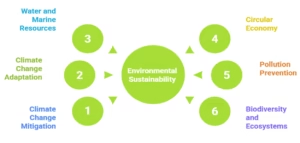
The first set of TSCs—covering only climate change mitigation and adaptation, was adopted in December 2021 and came into force in January 2022. A Complementary Climate Delegated Act, which added strict conditions for certain nuclear and natural gas activities, followed in July 2022 (applying from January 2023). Finally, in June 2023 the Commission adopted, and in November 2023 published the full package of TSCs for the remaining four environmental objectives (water protection, circular economy, pollution control, and biodiversity). These criteria became applicable as of January 2024, ensuring that every “Taxonomy‑aligned” activity must now meet precise performance thresholds and lifecycle safeguards before it can qualify.
Enabling vs Transitional activities
Within the scope of activities contributing to the environmental objectives, the Taxonomy also includes two specific categories:
Enabling Activities: Support other green activities (e.g., manufacturing wind‑turbine components). Must avoid “asset lock‑in” and show clear lifecycle benefits.
Transitional Activities: Bridge high‑emission sectors (e.g., cement with low‑carbon tech) when no feasible low‑carbon alternative exists, and demonstrate best‑in‑class emission performance.
Reporting & Disclosure Requirements
Beyond being a classification tool, the Taxonomy imposes new disclosure obligations. This is primarily achieved by amending the reporting requirements under the EU's Non-Financial Reporting Directive (NFRD) and the Sustainable Finance Disclosure Regulation (SFDR)
Regulation
Target
Disclosure Metrics
NFRD/CSRD (Art. 8)
Large Non Financial companies
% Turnover, CapEx, OpEx from Taxonomy‑aligned activities
SFDR (Art. 5–7)
Financial Products (Art. 8 & 9)
% Underlying investments in Taxonomy‑aligned activities; negative statements if none
Tools & Practical Guidance
The EU Commission has created resources to help users understand and implement the Taxonomy. The EU Taxonomy Navigator is a user-friendly website offering online tools. It includes:
Technical Screening Criteria[/caption]
To define the specific requirements and thresholds for an activity to be considered as making a substantial contribution and complying with the 'Do No Significant Harm' principle, the Commission develops Technical Screening Criteria (TSCs). These criteria are elaborated in secondary legislation known as Delegated Acts.
The first set of TSCs—covering only climate change mitigation and adaptation, was adopted in December 2021 and came into force in January 2022. A Complementary Climate Delegated Act, which added strict conditions for certain nuclear and natural gas activities, followed in July 2022 (applying from January 2023). Finally, in June 2023 the Commission adopted, and in November 2023 published the full package of TSCs for the remaining four environmental objectives (water protection, circular economy, pollution control, and biodiversity). These criteria became applicable as of January 2024, ensuring that every “Taxonomy‑aligned” activity must now meet precise performance thresholds and lifecycle safeguards before it can qualify.
Enabling vs Transitional activities
Within the scope of activities contributing to the environmental objectives, the Taxonomy also includes two specific categories:
Enabling Activities: Support other green activities (e.g., manufacturing wind‑turbine components). Must avoid “asset lock‑in” and show clear lifecycle benefits.
Transitional Activities: Bridge high‑emission sectors (e.g., cement with low‑carbon tech) when no feasible low‑carbon alternative exists, and demonstrate best‑in‑class emission performance.
Reporting & Disclosure Requirements
Beyond being a classification tool, the Taxonomy imposes new disclosure obligations. This is primarily achieved by amending the reporting requirements under the EU's Non-Financial Reporting Directive (NFRD) and the Sustainable Finance Disclosure Regulation (SFDR)
Regulation
Target
Disclosure Metrics
NFRD/CSRD (Art. 8)
Large Non Financial companies
% Turnover, CapEx, OpEx from Taxonomy‑aligned activities
SFDR (Art. 5–7)
Financial Products (Art. 8 & 9)
% Underlying investments in Taxonomy‑aligned activities; negative statements if none
Tools & Practical Guidance
The EU Commission has created resources to help users understand and implement the Taxonomy. The EU Taxonomy Navigator is a user-friendly website offering online tools. It includes:
- Defining “Sustainable”: Clear criteria for what counts as green
- Preventing Greenwashing: A trusted standard for financiers and issuers
- Driving Capital Flows: Incentivizing private-sector funding of clean activities
- Substantial Contribution: The activity must contribute to at least one of six environmental objectives listed in the Taxonomy
- Do No Significant Harm (DNSH) to the other five objectives
- Adherence to minimum social safeguards (e.g., human rights, labour standards)
- Full compliance with Technical Screening Criteria (TSCs) set in Delegated Acts
Technical Screening Criteria[/caption]
To define the specific requirements and thresholds for an activity to be considered as making a substantial contribution and complying with the 'Do No Significant Harm' principle, the Commission develops Technical Screening Criteria (TSCs). These criteria are elaborated in secondary legislation known as Delegated Acts.
The first set of TSCs—covering only climate change mitigation and adaptation, was adopted in December 2021 and came into force in January 2022. A Complementary Climate Delegated Act, which added strict conditions for certain nuclear and natural gas activities, followed in July 2022 (applying from January 2023). Finally, in June 2023 the Commission adopted, and in November 2023 published the full package of TSCs for the remaining four environmental objectives (water protection, circular economy, pollution control, and biodiversity). These criteria became applicable as of January 2024, ensuring that every “Taxonomy‑aligned” activity must now meet precise performance thresholds and lifecycle safeguards before it can qualify.
Enabling vs Transitional activities
Within the scope of activities contributing to the environmental objectives, the Taxonomy also includes two specific categories:
Enabling Activities: Support other green activities (e.g., manufacturing wind‑turbine components). Must avoid “asset lock‑in” and show clear lifecycle benefits.
Transitional Activities: Bridge high‑emission sectors (e.g., cement with low‑carbon tech) when no feasible low‑carbon alternative exists, and demonstrate best‑in‑class emission performance.
Reporting & Disclosure Requirements
Beyond being a classification tool, the Taxonomy imposes new disclosure obligations. This is primarily achieved by amending the reporting requirements under the EU's Non-Financial Reporting Directive (NFRD) and the Sustainable Finance Disclosure Regulation (SFDR)
Regulation
Target
Disclosure Metrics
NFRD/CSRD (Art. 8)
Large Non Financial companies
% Turnover, CapEx, OpEx from Taxonomy‑aligned activities
SFDR (Art. 5–7)
Financial Products (Art. 8 & 9)
% Underlying investments in Taxonomy‑aligned activities; negative statements if none
Tools & Practical Guidance
The EU Commission has created resources to help users understand and implement the Taxonomy. The EU Taxonomy Navigator is a user-friendly website offering online tools. It includes:
- Taxonomy Compass: Sector‑by‑sector mapping
- Taxonomy Calculator: Reporting walkthrough
- FAQs Repository & User Guide
- 20% average of corporate capital investments aligned
- €440 billion invested in Taxonomy‑aligned projects
- Utilities leading with 60%+ alignment
- 90% of EU public green bonds reference the Taxonomy
- 50%+ of large EU banks’ assets linked to in‑scope activities